Mini excavator buying guide: match model specs to job conditions
Quick answer
Choose a mini excavator on proven fit: transport math, attachment fit, proven service access, and current OEM specs. Specs define feasibility; price-only searches rarely predict job performance.
Common questions
- What matters most when comparing mini excavators?
- Match your site, transport limits, and attachment plan to published operating, reach, hydraulic, and undercarriage constraints before comparing prices.
- How do I choose between brands?
- Choose the machine that fits your workload and support plan first, then validate dealer response, part availability, and service access for your job site.
- What is the first technical step before buying?
- Build a model-to-site matrix with actual work dimensions, trailer payload, attachment flow requirements, and expected annual operating hours.
Source note: Reviewed 2026-08-31 with current OEM pages, official safety materials, and existing site calculators. Claims and comparisons are tied to published manufacturer specifications and linked documents.
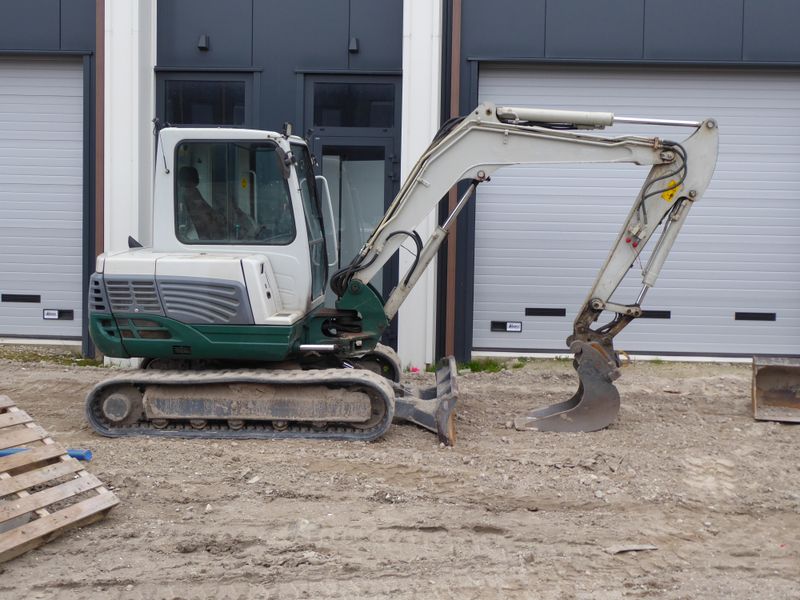
Mini excavators succeed when teams buy to a site workflow instead of a brochure.
This page does not rank brands. It helps you compare current model specs for your exact use case.
Scope and method used in this guide
This guide is for compact excavators in the 1.5-5 ton practical job class.
The model comparison below uses manufacturer pages published for current production families and is limited to fit-critical fields:
- operating weight,
- digging depth and ground reach,
- transport envelope,
- auxiliary hydraulic requirements,
- attachment controls.
The data is current as of 2026-08-31. We use the model pages directly and avoid unsupported brand-level claims.
Sources:
- OSHA material handling and equipment operation controls:
https://www.osha.gov/laws-regs/regulations/standardnumber/1926/1926.602
https://www.osha.gov/laws-regs/regulations/standardnumber/1926/1926.600 - AEM safety materials:
https://www.aem.org/safety-product-leadership/safety-materials - Bobcat compact excavator selection and model pages:
https://www.bobcat.com/na/en/buying-resources/excavators/compact-excavator-buyers-guide/key-factors-when-choosing
https://www.bobcat.com/na/en/equipment/excavators/compact-excavators/e35 - Cat model family page: https://www.cat.com/en_US/products/new/equipment/excavators/mini-excavators/108600.html
- Deere 35 P-tier overview and fleet specs: https://www.deere.com/en-us/industries/construction/all-about-excavators
- Deere 35 P fleet/brochure spec PDF: https://www.deere.com/assets/pdfs/common/products/sync/DKD1096-construction-equipment-fleet.pdf
What this guide helps with
You want a single-page decision framework for:
- choosing a model that fits work access,
- checking transport legalities before paying for transport gear,
- selecting attachment-capable machines,
- comparing dealer/service resilience,
- estimating total cost instead of relying on sticker price alone.
Current compact-class model comparison (as of 2026-08-31)
Use this as a starting shortlist, not as a ranking.
| Model | Operating weight* | Digging depth | Travel envelope** | Aux hydraulics** | Where it fits best |
|---|---|---|---|---|---|
| Bobcat E35 (standard) | 7,659 lb | 121.2 in (standard dig depth) | L 190 in, W 69.7 in, H 96.2 in | 2,987 psi, 16.9 gpm; optional secondary aux on many configurations | Mixed residential and light commercial tasks with a regular work envelope and standard utility trailer planning. |
| Deere 35 P (35P tier range) | 7,760 lb canopy / 8,135 lb cab (configuration dependent) | 120 in reported in Deere public overviews | varies by cab, stick, and ballast configuration | 16.2 gpm (OEM fleet documentation) | Contractors needing Deere ecosystem consistency and moderate utility tasks. |
| Caterpillar 303.5 CR | 7,673 lb (min) to 9,239 lb (max depending configuration) | 122.4 in (long stick variant listed) | L 190.9 in, W 70.1 in, H 97.6 in | published for model family, verify exact configuration before purchase | Sites requiring broader operator familiarity and configuration options with one- or two-way aux patterns. |
* Operating weight is configuration dependent where noted.
** Transport envelope and auxiliary figures are model-family baselines. Confirm your exact spec sheet and option package before final purchase.
Why this table is not a winner chart
The table is a fit tool. A heavy but slightly taller model may be better for bank excavation and worse for transport. A lower-profile unit may solve access but reduce counterweight options. A one-size ranking hides these tradeoffs, so choose by job requirements.
Core fit test before price discussion
Your first decision is not between brands; it is between workflows.
1) Job fit and geometry
List your tasks by measured depth and reach:
- trenching and pipe run,
- stump or root removal,
- digging pads or utility trenches,
- grading and grading cleanup,
- machine frequency per month.
If the published dig or reach does not match your required profile, the unit is a mismatch regardless of cost.
2) Transport and towing as a mandatory pre-purchase step
Transport math should be done before financing or purchase:
- machine weight plus counterweight and attachments,
- trailer unladen and loaded capacity limits,
- truck towing and GCWR rating,
- total setup height, length, brake requirement, wheelbase, and permit requirements.
Build your payload check in one worksheet:
payload available = trailer rating - (machine + attachment + fuel + fluid + ballast margin)
If the result is negative or leaves no legal margin, do not force this model into your transport plan.
Ask your local dealer for a transport fit review before signing.
Do not assume your license category allows all setups. Confirm your state and route requirements for the actual transport package.
3) Auxiliary hydraulics and attachment fit
The attachment plan fails after first purchase more often than the engine spec. Compare:
- flow (gpm),
- system pressure (psi),
- coupler type and count,
- one-way/two-way control direction,
- continuous vs on-demand valve behavior,
- hose quick-connect geometry.
The operator needs to run the same day with planned tools. If the aux flow is below attachment minimum, runtime and productivity both drop.
4) Service, parts, and parts lead-time as decision-critical
Dealer support should be a scoring dimension equal to lift performance:
- parts shelf availability by your model,
- field service response expectations,
- labor and technician familiarity in your region,
- in-house or nearby machine rental backup options,
- warranty administration details for used vs new.
Do not treat this as a soft item. Downtime cost can outweigh fuel savings and daily depreciation differences quickly.
New, used, and rental decisions using evidence
Use current workload to decide:
- Rent when your annual use is limited and project type changes frequently.
- Buy used when your production plan already requires a stable fleet and you can verify maintenance records.
- Buy new for intensive repeated use and strict uptime requirements.
This guide remains evidence-first even on ownership:
- Use the site tool before setting budget assumptions: https://www.ironworksinsider.com/tools/equipment-ownership-cost-calculator/
- Add transport, parts, storage, insurance, tire/track wear, and service downtime.
- Run three scenarios: low season, base season, and peak.
Decision worksheet: fit matrix
Rate each candidate from 1-5 using your workload:
- Access envelope fit,
- Required trench depth and reach,
- Transport legality and setup cost,
- Attachment compatibility,
- Dealer service strength,
- Operator comfort and training time.
Score the best-fit model by weighted purpose:
- Homeowner/light contractor: access + transport + attachment priority.
- Landscaper: service + cycle speed + accessory support.
- Utility/production contractor: uptime + productivity + dealer response.
Useful safety and operation reminders
- Use PPE and lock-out procedures for all movement and maintenance tasks.
- Confirm stability, swing envelope, and trench side risks before entering active trenches.
- Use official training and manufacturer operating manuals for all machine-specific configurations.
- Keep daily inspection records for transport and pre-op checks.
What to do before you sign
- Download the exact configuration sheet from OEM sales.
- Confirm aux circuit specs with your attachment distributor.
- Ask dealer for estimated parts lead times on your exact model and serial-equivalent package.
- Validate towing math against the exact trailer, hitch, and route.
- Review total ownership estimates with a 3-year horizon.
The best mini excavator decision is not about choosing “the most famous” machine.
It is about choosing the model that is mechanically and logistically feasible for the work you actually run.
Model compact excavator ownership before choosing a brand
These resources connect compact-excavator specs with inspection, transport, financing, maintenance, and rent-vs-buy math.
- Equipment ownership cost calculator
Compare utilization, financing, maintenance, downtime, transport, and resale assumptions.
- How to inspect a used excavator
Check pins, bushings, undercarriage, hydraulics, leaks, and service records before buying used.
- Excavator sizes explained
Compare mini, midi, and full-size classes before narrowing weight range.
- Excavator attachments
Match hydraulic flow, couplers, controls, and attachment requirements to the machine.
- Equipment rental vs. buy
Decide whether job hours and downtime exposure support ownership.
- Equipment transport guide
Check trailer, tow vehicle, route, tie-down, and permit constraints before buying.
- Equipment maintenance reserve planner
Plan repair reserves and downtime risk before choosing a compact excavator to own.

Ironworks Insider Editorial Team
Independent trade-focused editorial team